Choosing the best China supplier for a titanium exhaust manifold stud bolt requires more than comparing prices. Heat, vibration, corrosion, and repeated thermal cycling can quickly expose weak material or poor thread quality. A reliable supplier should provide alloy certificates, dimensional reports, tensile results, and traceable production records.
Industry reports from Grand View Research and IMARC identify continued demand for titanium components in aerospace, motorsport, and high-performance automotive applications. These reports also highlight titanium’s high strength-to-weight ratio and corrosion resistance. However, market growth does not prove that every supplier meets engineering requirements. That distinction matters.
Matthew J. Donachie, author of Titanium: A Technical Guide, offers a useful engineering principle: “Alloy selection must follow service conditions.” For a titanium exhaust manifold stud bolt, that means reviewing temperature exposure, preload, thread engagement, galvanic contact, and installation torque. The strongest-looking bolt may still fail if the mating material or tightening method is unsuitable.
A capable Chinese manufacturer should explain its grade selection clearly. Common options may include commercially pure titanium or titanium alloys, depending on the application. Production details matter too. Look for CNC thread control, controlled heat treatment, surface inspection, and documented quality checks. Ask for samples before placing a large order.
Some supplier pages promise exceptional performance without showing test evidence. That is a weakness worth questioning. A careful buyer should verify reports through independent inspection when the application is safety-critical. The best supplier is not simply the cheapest factory. It is the manufacturer that can connect material data, process control, and real exhaust-system experience.
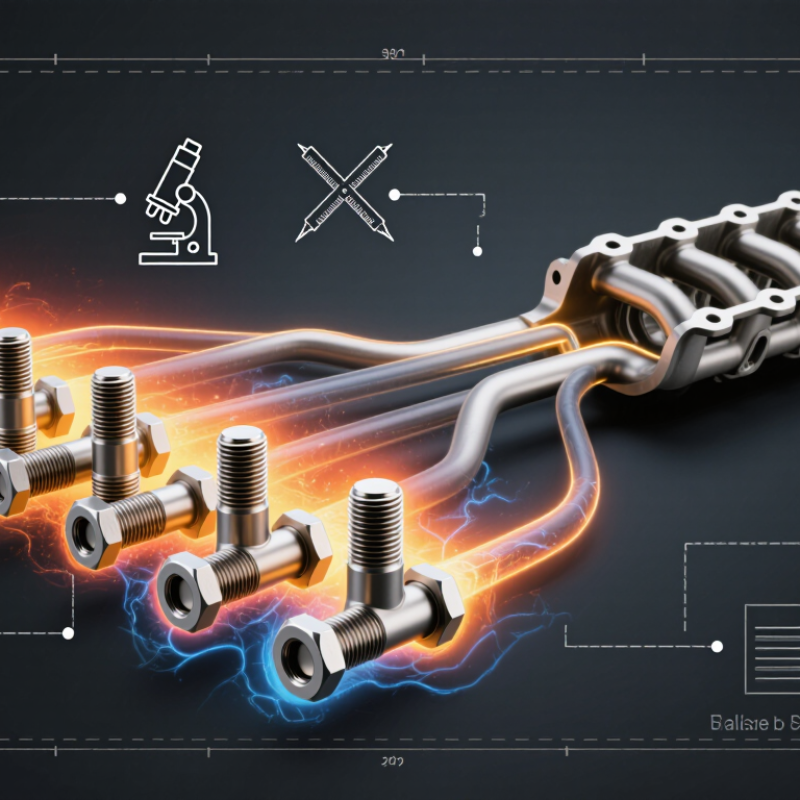
A titanium exhaust manifold stud bolt is a threaded fastener designed to secure the manifold to an engine cylinder head. Most performance versions use Ti-6Al-4V alloy, not commercially pure titanium. The alloy offers high strength with low mass. ASM Handbook data lists its density near 4.43 g/cm³, compared with about 7.85 g/cm³ for carbon steel. That can reduce hardware weight around the engine.
It is not automatically the best choice.
Titanium also has drawbacks. Its elastic modulus is roughly half that of steel, so it stretches more under the same load. Its thermal expansion differs from common steel parts. ASTM fastener guidance and field testing also highlight galling risks during installation. Apply suitable anti-seize, control torque carefully, and avoid using impact tools. In high-temperature exhaust zones, titanium can lose strength faster than heat-resistant steel or nickel alloys. This point is often overlooked.
A dependable supplier should provide alloy certificates, dimensional inspection records, thread tolerances, and heat-treatment information. The USGS Mineral Commodity Summaries identifies titanium sponge as a controlled upstream material, making traceability important. My practical concern is simple: a lightweight stud still needs stable clamp load after repeated heat cycles. Laboratory figures cannot replace engine-side testing. A supplier with useful experience should disclose temperature limits, recommended torque, and galling-prevention procedures. Weight savings matter, but failed threads are expensive.
Titanium is attractive for exhaust manifold stud bolts because it combines low mass with strong corrosion resistance. The ASM Handbook reports a density near 4.5 g/cm³ for titanium alloys, compared with about 7.8 g/cm³ for carbon steel. That difference can reduce fastener weight, especially across large engine assemblies. Titanium also forms a stable oxide film, helping resist moisture, road salt, and combustion by-products. However, lighter does not mean automatically better.
Heat changes the calculation. SAE exhaust-system studies commonly record manifold surface temperatures above 600°C under demanding engine conditions. At these temperatures, titanium loses strength faster than many high-temperature nickel alloys. Thread galling is another practical concern. During installation, dry titanium threads may seize, even when the bolt appears undamaged. Controlled torque and a compatible high-temperature anti-seize compound are essential. Small details matter.
Titanium also has a lower elastic modulus than steel, so joint preload can change more under thermal cycling. This is why engineers should check clamp load, thread engagement, and flange movement together. ASTM B348 defines requirements for titanium bars and billets, but it does not guarantee suitability for every exhaust design. A careful supplier should provide alloy certification, hardness data, dimensional inspection, and traceable heat numbers. In my experience, titanium works well for weight-sensitive, corrosion-prone applications, but selecting it only for its appearance is a weak decision.
Evaluating a Chinese supplier requires more than comparing quotation prices. Start with material control. Ask for the titanium grade, heat number, and EN 10204 3.1 material certificate. For common high-strength applications, verify chemistry, tensile strength, hardness, and elongation against the agreed standard. ASTM specifications may help, but the drawing and service temperature must govern the final decision.
Request a controlled sample set, not one polished bolt. Check thread size, pitch, shank diameter, length, and surface condition with calibrated tools. A reliable factory should provide inspection records, traceability, and clear nonconformance procedures.
Ask how it prevents titanium galling during assembly. Thread fit, lubrication guidance, and installation torque matter in real workshops. Small details matter.
Exhaust systems face vibration, thermal cycling, and corrosion. Titanium may offer useful weight savings, but it does not automatically suit every manifold temperature. Ask for temperature data, load assumptions, and any coating limitations. A factory audit can reveal practical issues, such as mixed material bins or incomplete calibration records.
I have seen impressive samples hide weak batch control. That risk deserves attention. Review production capacity, lead times, packaging, and corrective-action history before approving regular orders. Supplier confidence should come from repeatable evidence, not confident emails.
China Best Titanium Exhaust Manifold Stud Bolt Supplier?
When comparing suppliers, inspect the manufacturing process rather than the product photos. Ask for material certificates, heat-treatment records, and batch traceability. The certificate should identify the titanium grade, chemical composition, and mechanical properties. For exhaust applications, confirm performance after repeated heat cycles. A bolt that looks perfect at room temperature may loosen after months of vibration and expansion.
Tips: Request sample studs from the same production batch. Check thread accuracy with calibrated gauges, not only by hand. Examine the threads under magnification for tearing, dents, or uneven roots. Ask for tensile test results and dimensional inspection reports. A supplier should explain its testing frequency clearly. If answers remain vague, reliability is still unproven.
Surface treatment also matters. Titanium threads can gall during installation, especially with high tightening pressure. Confirm whether the supplier recommends a compatible lubricant and provides torque guidance. Review packaging carefully; damaged threads often begin with poor handling. In practical inspections, small burrs have caused serious assembly delays. However, test reports alone are not enough. They may represent another batch, or an ideal sample. Independent verification is worth considering for critical orders. I would also compare several samples after installation and removal. This reveals whether the threads deform too easily. A lower price can be attractive, but inconsistent hardness, poor traceability, or unstable dimensions may cost more later.
| Evaluation Dimension | Reliable Product or Supplier Benchmark | Relevant Technical Reference | Recommended Verification Evidence | Importance |
|---|---|---|---|---|
| Material Grade | Clearly specified titanium grade, such as Ti-6Al-4V Grade 5, with no vague descriptions such as “premium titanium.” | ASTM B348 or another applicable material standard for titanium and titanium alloy bars and billets. | Material certificate showing grade, heat number, chemical composition, mechanical properties, and supplier traceability. | Critical |
| Chemical Composition | Measured alloy composition must remain within the limits required by the declared material specification, including aluminum, vanadium, iron, oxygen, carbon, nitrogen, and hydrogen. | Applicable ASTM, ISO, or national titanium alloy specification. | Third-party or in-house optical emission spectroscopy, X-ray fluorescence, or equivalent laboratory report linked to the production heat. | Critical |
| Mechanical Properties | For Grade 5 titanium in a commonly referenced annealed bar condition, typical minimum requirements include approximately 895 MPa tensile strength, 828 MPa yield strength, and 10% elongation. The purchase specification must define the exact condition. | ASTM B348 requirements vary by product size and heat-treatment condition. | Mill test certificate and tensile-test report identifying specimen direction, test temperature, batch, and heat-treatment condition. | Critical |
| Operating Temperature Suitability | Supplier must provide a temperature limit based on the actual alloy, preload, exposure time, oxidation environment, and exhaust-system design. Titanium is not automatically suitable for every high-temperature manifold location. | Design validation should use application-specific elevated-temperature data rather than room-temperature tensile values alone. | Elevated-temperature strength data, thermal-cycle test results, and written installation recommendations. | Critical |
| Thread Standard and Fit | Thread diameter, pitch, class, length, end configuration, and tolerance must be stated on the drawing or purchase order. Metric and Unified threads must not be mixed. | ISO 965 for metric threads, ASME B1.1 for Unified threads, or the customer’s approved drawing. | Thread plug or ring gauge records, calibrated dimensional inspection reports, and first-article inspection results. | Critical |
| Dimensional Accuracy | Critical dimensions such as major diameter, thread length, overall length, shoulder location, and chamfer must remain within drawing tolerances. | Approved engineering drawing and applicable dimensional tolerances. | Coordinate-measuring-machine report, calibrated micrometer records, and inspection sampling plan. | High |
| Surface Condition | Threads should be clean, continuous, and free from burrs, laps, cracks, deep tool marks, embedded particles, and visible corrosion. The required surface finish should be specified where functionally important. | Customer drawing, general machining tolerances, and agreed visual acceptance standard. | Visual inspection records, surface-finish measurements where required, and sample photographs linked to the lot. | High |
| Galling Control | Titanium threads are susceptible to galling, especially during dry installation. A reliable supply program should define thread lubrication, coating, installation speed, and torque requirements. | Application-specific assembly procedure; torque values must be validated for the selected lubricant or coating. | Assembly torque-tension test, repeated installation test, lubricant or coating specification, and installation instructions. | Critical |
| Heat Treatment | Heat-treatment condition must be consistent with the required strength, ductility, and dimensional stability. Any annealing or stress-relief process should be documented. | Material specification and approved process route for the selected titanium grade. | Heat-treatment chart, furnace calibration record, batch number, and hardness or tensile verification where applicable. | High |
| Non-Destructive Testing | For safety-critical or highly loaded studs, inspection should be risk-based and may include dye penetrant, ultrasonic, or other suitable methods. | Agreed inspection plan and applicable NDT procedure qualification requirements. | NDT reports showing method, acceptance criteria, inspector qualification, lot number, and disposition of rejected parts. | High |
| Manufacturing Process Control | Stable control of raw-material identification, forging or machining, thread production, cleaning, inspection, and packaging is more reliable than final visual inspection alone. | Documented quality-management procedures and controlled work instructions. | Process flow chart, control plan, inspection records, calibration certificates, and corrective-action history with sensitive commercial details removed. | High |
| Batch Traceability | Every shipment should be traceable to a material heat, production lot, inspection record, and packaging label. | Lot-control and identification procedure agreed before production. | Matching heat number, lot number, certificate, inspection report, and carton label. | Critical |
| Coating or Surface Treatment | If a coating or anti-seize treatment is used, its composition, thickness, temperature capability, and compatibility with titanium and mating materials must be defined. | Approved coating specification and application-specific thermal and chemical compatibility requirements. | Coating certificate, thickness measurement, adhesion or durability test, and compatibility statement. | High |
| Corrosion and Galvanic Compatibility | Supplier evaluation should consider contact with steel, stainless steel, aluminum, and exhaust condensate. Dissimilar-metal contact may require isolation or an approved compound. | Application-specific corrosion assessment and assembly design requirements. | Material compatibility review, salt-spray or environmental test where relevant, and installation guidance. | High |
| Packaging and Cleanliness | Parts should be protected from thread damage, contamination, moisture, and mixed-lot identification during transport and storage. | Customer packaging specification and standard export handling practices. | Packaging inspection, corrosion-protection method, moisture-control record, and clear lot labeling. | Medium |
| Quality Consistency | Repeated production lots should demonstrate stable dimensions, mechanical properties, surface condition, and defect rates rather than relying on one good sample. | Statistical process control or a documented sampling plan appropriate to order volume and risk. | Multi-lot inspection data, capability studies for critical dimensions, nonconformance rate, and corrective-action records. | High |
| Pre-Production Validation | A first-article sample should be tested in the actual manifold, nut, washer, lubricant, and torque procedure before mass production. | Approved prototype and first-article inspection procedure. | Fit test, torque-tension test, thermal-cycle test, removal test, and signed first-article approval. | Critical |
| Documentation and Support | A dependable supplier provides clear drawings, certificates, inspection data, installation guidance, and prompt technical responses without changing specifications informally. | Agreed technical file and change-control procedure. | Document checklist, revision-controlled drawings, response-time record, and formal engineering-change notices. | High |
| Supplier Comparison Method | Use a weighted score instead of comparing price alone. Suggested weighting: material and traceability 25%, dimensional and thread quality 20%, thermal and galling validation 25%, process control 15%, documentation 10%, packaging and service 5%. | Weighted supplier scorecard based on the project’s actual failure risks. | Score each supplier from 0 to 5, require evidence for every score, and reject any supplier failing a critical requirement. | Critical |
China Best Titanium Exhaust Manifold Stud Bolt Supplier?
Before placing an order, verify the supplier’s titanium grade, heat-treatment records, and lot traceability. For exhaust manifolds, Grade 5 titanium is common, but the specification must match the engine’s temperature and load requirements. Ask for mill certificates, chemical analysis, tensile results, and hardness data. ASTM F606/F606M provides recognized test methods for fastener mechanical properties.
Check the complete drawing, not only the bolt diameter. Thread pitch, engagement length, shank tolerance, head geometry, and nut compatibility can affect installation. Request sample studs for dimensional inspection and torque testing. A reliable supplier should provide torque-preload curves, coating details, and batch numbers. The 2024 U.S. Geological Survey Mineral Commodity Summaries highlights titanium’s globally concentrated supply chain. This makes origin records and supply continuity important, especially for repeated automotive orders.
Inspect how the factory controls heat and thread forming. Excessive machining stress may cause cracking during thermal cycling. Ask for fatigue or high-temperature test results using conditions close to your application. I would also review packaging. Titanium threads can gall when installed dry, even when the material certificate looks perfect. A mistake I have seen is trusting polished samples too quickly. Production lots may differ. No checklist is perfect. Include an independent inspection before shipment, and confirm rejection procedures, replacement timing, and retained samples in the purchase agreement.
Before placing an order, confirm the titanium grade and its certified mechanical properties. The chart compares the minimum tensile strength requirements commonly specified for titanium products under ASTM B348.
Titanium is much lighter than carbon steel, with density near 4.5 g/cm³. It also resists moisture, road salt, and combustion by-products. That helps in corrosion-prone engine areas. Lighter is not automatically better.
Exhaust manifold surfaces can exceed 600°C during demanding operation. Titanium loses strength faster than many high-temperature alloys. Check the actual temperature range before selecting it. Heat changes everything.
Titanium threads can gall and seize during dry installation. Use a compatible high-temperature anti-seize compound. Apply controlled torque and avoid excessive tightening pressure. A damaged thread may look acceptable at first.
Check clamp load, thread engagement, and flange movement together. Titanium has a lower elastic modulus than steel. Thermal cycling can change preload more noticeably. The joint may loosen later.
Request material certificates, chemical composition, and mechanical properties. Ask for hardness data and dimensional inspection reports. Heat-treatment records and batch traceability are also important. Vague answers leave reliability unproven.
Use calibrated thread gauges instead of relying only on hand fitting. Inspect thread roots under magnification. Look for tearing, dents, burrs, and uneven surfaces. Small burrs can delay assembly.
Yes, request samples from the same batch as the order. Test them before approving large quantities. Install and remove several studs carefully. This can reveal excessive thread deformation.
No. Reports may describe another batch or an ideal sample. Independent verification is sensible for critical applications. Compare dimensions, hardness, and thread condition after testing. I might overvalue paperwork sometimes.
A lower price can hide unstable dimensions, poor traceability, or inconsistent hardness. Compare total installation risk, not only unit cost. Reliable packaging also protects threads during transport. Cheap can become expensive.
A titanium exhaust manifold stud bolt is a threaded fastener designed to secure an exhaust manifold while tolerating high temperatures, vibration, and repeated thermal expansion. Titanium is often selected for its low weight, strong corrosion resistance, and favorable strength-to-weight ratio. However, material choice alone does not guarantee performance; thread accuracy, dimensional consistency, surface condition, and resistance to heat-related stress are equally important.
When evaluating a Chinese supplier, buyers should review material specifications, production capabilities, quality-control procedures, testing methods, and compliance with relevant industry standards. Comparing manufacturing quality means checking raw-material traceability, machining precision, thread inspection, heat and corrosion testing, packaging, and consistency between production batches. Before placing an order, confirm drawings, tolerances, grades, sample approval, minimum order quantities, lead times, inspection reports, and after-sales communication. A reliable supplier should provide clear technical documentation and demonstrate stable production rather than relying only on low pricing.