Choosing the right fastener for a demanding assembly starts with more than appearance. The DIN912 titanium socket head cap screw combines a compact head, internal hex drive, and corrosion-resistant titanium construction. Its value depends on the grade, thread accuracy, heat treatment, and supplier documentation.
In practical workshop use, titanium screws feel light but require careful installation. Their low density helps reduce weight in bicycles, robotics, marine equipment, and aerospace-adjacent assemblies. However, titanium can gall when threads run dry or receive excessive torque. A controlled tightening process matters. Clean threads matter too.
Details matter.
This 2026 guide examines the features that separate dependable DIN912 titanium socket head cap screw products from ordinary alternatives. It considers titanium grades, strength data, dimensional consistency, surface treatments, and available certificates. We will also discuss socket fit, thread engagement, washer selection, and anti-seize compatibility.
The strongest specification is not always the best choice. A high-strength alloy may complicate machining or increase cost without improving the finished assembly. That point is easy to overlook. Product listings can also contain incomplete grade information, unclear tolerance statements, or outdated references. Buyers should verify technical datasheets and batch traceability before ordering.
Our assessment follows established engineering practice and practical installation concerns. It does not treat one supplier or coating as universally superior. Instead, it compares measurable factors against real application needs. Some recommendations may require reconsideration as manufacturers update materials and testing methods. That uncertainty deserves honest attention.
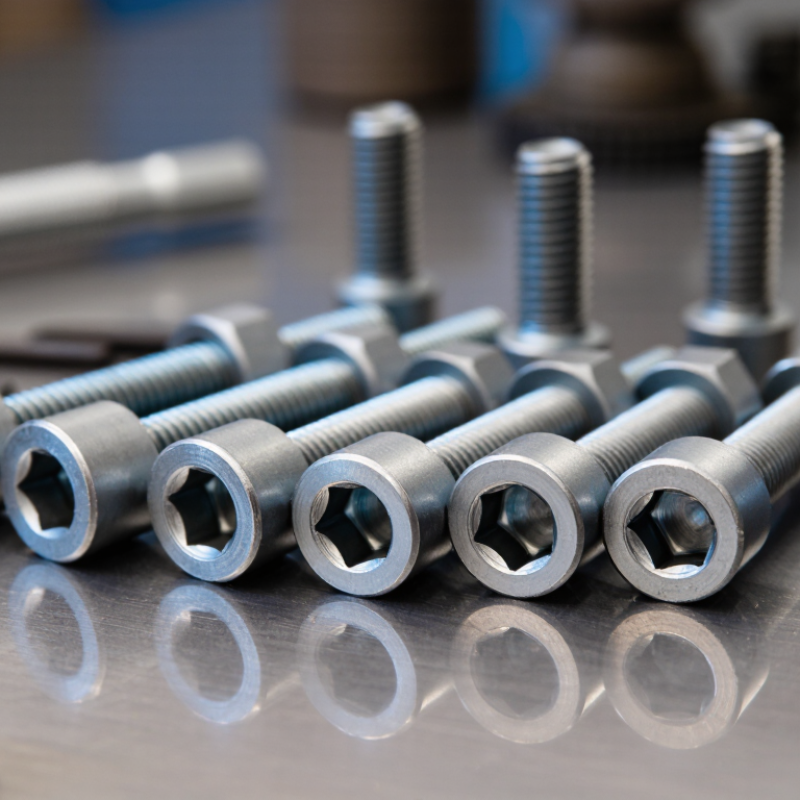
DIN 912 titanium socket head cap screws follow a recognized head and drive design. The standard defines dimensions, socket geometry, and thread basics. Material selection remains separate. That distinction matters.
For titanium fasteners, specify the alloy, strength class, thread tolerance, and surface condition. ISO 4762 is the closely related international reference for socket head cap screws. However, a DIN 912 callout alone cannot prove titanium grade or tensile performance. ASTM F468 can support requirements for nonferrous screws, including selected titanium alloys. Always check the latest edition and the supplier’s material certificate. Small details matter.
The USGS Mineral Commodity Summaries 2025 estimated global titanium mineral concentrate production at roughly nine million metric tons in 2024. This figure describes upstream supply, not finished screw quality. It still shows why traceability deserves attention. A reliable inspection plan checks thread dimensions, head height, socket depth, hardness, and chemical composition. Titanium also resists corrosion well, but it can gall during installation. Controlled torque helps. A lubricant or suitable surface treatment may be necessary, depending on the joint design. The word “best” is slightly misleading here. The correct DIN 912 titanium screw depends on load, temperature, vibration, and repeated servicing. A perfect-looking screw can still fail a poorly defined specification.
DIN 912, harmonized with ISO 4762, defines the dimensional series for socket head cap screws. The chart compares the standard nominal head diameter and head height from M2 to M12. Titanium grade selection should be based on strength, corrosion resistance, temperature, and application requirements.
Dimensions shown in millimeters; values are based on the DIN 912 / ISO 4762 metric dimensional series.
2026 Best DIN912 Titanium Socket Head Cap Screw?
DIN 912 defines the socket head cap screw’s geometry, not its titanium alloy or performance. That distinction matters. Grade 2 titanium offers excellent corrosion resistance and easy availability, but its lower strength suits light-duty assemblies. Grade 5 titanium, usually Ti-6Al-4V, provides much higher tensile strength, often near 895 MPa in common fastener conditions. It is a practical choice for weight-sensitive structures, machinery, and outdoor equipment.
Strength is not the only decision. Grade 7 titanium, modified with palladium, can perform better in strongly reducing chemical environments. Grade 2 remains highly resistant to seawater and many chlorides, although stagnant crevices may still cause problems. Grade 5 resists general corrosion well, yet its alloying elements do not make it immune to every chemical exposure. Test the actual fluid, temperature, and stress combination.
Thread behavior deserves attention. Titanium threads can gall during installation, especially with repeated dry assembly. Use a compatible anti-seize compound and controlled torque, but verify its effect on preload. Torque tables vary with lubrication, surface finish, and thread condition. A clean M6 screw may feel secure while delivering inconsistent clamping force. That is easy to overlook. Isolate titanium from dissimilar metals when galvanic corrosion is possible, particularly in wet salt environments. Inspect washers, mating threads, and crevices, not just the screw head. A small design trial is often wiser than trusting a generic strength number.
2026 Best DIN912 Titanium Socket Head Cap Screw?
Key Criteria for Choosing the Best Screw in 2026
Choosing the best DIN 912 titanium socket head cap screw starts with the application, not the catalogue photograph. Check the required diameter, thread pitch, length, and engagement depth. DIN 912 dimensions generally align with ISO 4762, but the material grade still needs separate verification. Grade 5 titanium offers high strength and low weight. Grade 2 may suit less demanding corrosion-resistant assemblies. Fit matters. A clean, accurate thread prevents cross-threading during installation.
Strength is only one criterion. Review tensile strength, proof load, hardness, and stated manufacturing tolerances. Titanium has a lower elastic modulus than steel, so identical torque values can produce different preload. Use a torque procedure tested for the exact screw, lubrication, and joint material. Avoid guessing. Inspect the hex socket for rounded edges, incomplete machining, or surface damage. These small defects can appear after repeated tool use.
The surrounding materials also deserve attention. Titanium can experience galling, especially when dry and repeatedly tightened. A suitable approved lubricant or coating may reduce this risk, but it can also change preload. Test the complete assembly rather than relying on a generic torque chart. For outdoor or marine environments, confirm corrosion behavior and possible galvanic interaction with aluminum. Request material certificates, dimensional inspection records, and batch traceability. I would also check samples before ordering large quantities. Specifications can look convincing, yet real-world fit sometimes exposes details the datasheet misses.
| Selection Criterion | Recommended 2026 Specification | Useful Technical Data | Why It Matters |
|---|---|---|---|
| Standards and Product Definition | |||
| Dimensional standard | DIN 912 / ISO 4762 form | ISO 4762 is the current international reference for hexagon socket head cap screws; DIN 912 is commonly retained as the legacy designation. | Confirm the drawing, purchase specification, and inspection method use the same standard because head dimensions and tolerances must match the assembly. |
| Thread system | Metric coarse thread, ISO metric profile | Common pitches include M3 × 0.5, M4 × 0.7, M5 × 0.8, M6 × 1.0, M8 × 1.25, and M10 × 1.5. | Coarse threads are widely available and generally provide better tolerance to contamination and handling damage than fine threads. |
| Material grade | Titanium Grade 5, Ti-6Al-4V | Typical alloy composition is approximately 6% aluminium and 4% vanadium, with the balance titanium. | Grade 5 offers a strong combination of low density, corrosion resistance, and mechanical strength for demanding applications. |
| Mechanical and Environmental Performance | |||
| Minimum tensile strength target | At least 895 MPa where the applicable material specification requires it | Grade 5 titanium fastener requirements vary by product standard, diameter, heat treatment, and manufacturing condition. | Do not use a generic alloy value as a substitute for the certificate or standard specified for the finished fastener. |
| Minimum yield-strength target | At least 828 MPa where the applicable specification requires it | Actual values depend on the fastener standard, thread size, heat treatment, and test direction. | Yield strength is important where the screw is subjected to repeated preload, vibration, or high structural loads. |
| Density advantage | Approximately 4.43 g/cm³ | Steel is approximately 7.85 g/cm³, so an equivalent titanium screw is substantially lighter. | Lower mass is valuable in aerospace, motorsport, robotics, marine equipment, and other weight-sensitive assemblies. |
| Temperature capability | Verify the complete application temperature range | Titanium alloy performance is affected by temperature, preload, oxidation conditions, and exposure time. | A screw suitable for room-temperature service should not automatically be qualified for elevated-temperature or cryogenic use. |
| Corrosion resistance | High resistance in many atmospheric, marine, and chloride-containing environments | Titanium forms a stable passive oxide film; performance still depends on the exact chemical environment and surface condition. | Useful where corrosion resistance and low weight are required, but compatibility with mating metals must also be evaluated. |
| Galvanic compatibility | Assess contact with aluminium, magnesium, and carbon-fiber assemblies | Direct contact between dissimilar conductive materials in the presence of an electrolyte can cause galvanic corrosion. | Use suitable isolation washers, coatings, sealants, or approved interface treatments when required by the design. |
| Representative ISO 4762 / DIN 912 Dimensions | |||
| Thread size | Nominal coarse pitch | Typical head diameter × head height; internal hexagon size | Selection guidance |
| M3 | 0.5 mm | 5.5 mm × 3.0 mm; 2.5 mm socket | Suitable for compact, lightly loaded assemblies where installation access is limited. |
| M4 | 0.7 mm | 7.0 mm × 4.0 mm; 3.0 mm socket | Common for small equipment, instruments, brackets, and precision mechanisms. |
| M5 | 0.8 mm | 8.5 mm × 5.0 mm; 4.0 mm socket | A practical general-purpose size for moderate clamp loads and compact structures. |
| M6 | 1.0 mm | 10.0 mm × 6.0 mm; 5.0 mm socket | A widely used size for machinery, frames, vehicle components, and structural brackets. |
| M8 | 1.25 mm | 13.0 mm × 8.0 mm; 6.0 mm socket | Suitable for higher clamp loads when the joint, thread engagement, and surrounding material are adequately designed. |
| M10 | 1.5 mm | 16.0 mm × 10.0 mm; 8.0 mm socket | Used for larger structural joints; check clearance around the head and the strength of the tapped material. |
| Manufacturing, Quality, and Installation Checks | |||
| Thread quality | Full dimensional inspection to the specified tolerance class | Check pitch diameter, major diameter, thread form, runout, burrs, and effective thread length. | Clean, accurately formed threads improve fit, preload consistency, and resistance to galling. |
| Surface finish | Clean, burr-free, and suitable for the application | Surface treatment, lubricant, coating, and passivation requirements should be stated separately from the base alloy. | Surface condition affects friction, galling resistance, corrosion behavior, and torque-to-tension consistency. |
| Anti-galling control | Use an approved lubricant or coating compatible with the joint | Titanium threads can gall, especially during repeated assembly or dry installation. | Do not assume that a standard torque value applies after changing the lubricant, coating, or surface treatment. |
| Torque specification | Calculate or validate for the exact joint | Torque depends on nominal diameter, tensile stress area, target preload, friction coefficient, lubrication, and joint stiffness. | A universal torque table is unreliable for titanium fasteners; torque should be verified by engineering calculation or test. |
| Traceability documentation | Require material and dimensional certificates for critical applications | Documentation may include alloy chemistry, mechanical test results, lot number, heat treatment, and inspection records. | Traceability helps demonstrate conformity and supports failure analysis, maintenance, and regulated-industry requirements. |
| Final selection rule | Choose the screw that satisfies strength, geometry, environment, preload, and installation requirements together | Material grade alone does not determine suitability; joint design and the mating component often control performance. | The best 2026 choice is the fully documented, correctly dimensioned, application-qualified screw—not simply the lightest option. |
| Technical note: Dimensions shown are representative ISO 4762 / DIN 912 coarse-thread values for common sizes. Always verify the applicable edition of the standard, product specification, tolerance class, material condition, and installation procedure before production use. | |||
For a 2026 DIN 912 titanium socket head cap screw, dimensions must match the mating thread, not only the nominal diameter. DIN 912 is aligned with ISO 4762 geometry, including the cylindrical head and internal hexagon. Common sizes include M6 × 1.0, M8 × 1.25, and M10 × 1.5. ISO 965 thread tolerances should guide compatibility, typically using a 6g external thread with a 6H internal thread. Fine threads can improve adjustment and stripping resistance, but they require cleaner alignment.
Load selection needs more than a tensile-strength comparison. ASTM F467 data for titanium alloy fasteners commonly lists Grade 5 tensile strength near 895 MPa, depending on product condition and testing. Titanium’s elastic modulus is about 105–120 GPa, far below steel’s approximate 200 GPa. The screw therefore stretches more under the same load. That affects preload retention. NASA’s Fastener Design Manual, NASA-RP-1228, also warns that torque alone gives inconsistent preload because friction changes sharply with surface condition and lubrication.
Use the manufacturer’s tested torque values. Do not copy steel torque tables. A practical target often begins near 60–70% of verified proof load, then receives engineering review for vibration, joint separation, and embedment. This is not universal. Titanium threads can gall during installation, especially after repeated tightening. Anti-seize may reduce friction too much. I have seen torque values look correct while clamp load remained inadequate. The overlooked detail is joint stiffness. Calculate it before choosing the “best” screw.
A DIN912 titanium screw should be selected by grade, thread engagement, and service temperature. DIN912 defines the geometry, not every material property. ASTM F467/F467M reports Grade 5 titanium with approximately 895 MPa minimum tensile strength. That figure still depends on heat treatment, batch control, and inspection records. Check the material certificate.
Installation deserves more attention than the catalog description. Clean both threads and remove chips from the socket head. Apply a compatible anti-seize compound when galling is possible. Titanium threads can seize during tightening, especially with dry contact and repeated assembly. NASA-RP-1228 explains that roughly 90% of applied torque may be lost through friction. Only a small portion creates useful clamp load. A torque wrench alone can therefore mislead. Calibrated torque-tension testing is better for critical joints. Start gently.
Thread engagement should usually provide enough load-bearing length for the parent material, not merely the screw diameter. Avoid forcing a screw through misaligned holes. That practice damages threads before service begins. ASM Handbook guidance on titanium also highlights galling and surface damage as important durability concerns.
Inspect the first installation, then inspect again after thermal cycling or vibration exposure. Galvanic contact with dissimilar metals may require isolation washers or coatings. A convenient torque chart is helpful, but it is not truth. Real friction, lubricant condition, and operator technique can change the result.
Check diameter, thread pitch, length, engagement depth, material grade, and service conditions. A catalog image is not enough.
No. Dimensional standards describe geometry, such as the cylindrical head and internal hexagon. Material certificates need separate verification.
A high-strength alloy grade may suit demanding loads. A commercially pure grade may fit lighter, corrosion-focused assemblies. Confirm test data.
Match the screw thread with the mating internal thread. Check tolerance class, alignment, pitch, and hole condition before installation.
No. Titanium stretches differently, and friction changes preload. Use tested torque values for the exact screw, lubricant, and joint.
Clean both threads, remove chips, and use a compatible lubricant when approved. Tighten slowly. Dry repeated assembly increases seizure risk.
Engagement must provide sufficient load-bearing length in the parent material. It should not rely only on matching the screw diameter.
Inspect sample threads, socket edges, surface finish, dimensions, and certificates. Real fit can reveal details that specifications miss.
Outdoor or marine assemblies may need isolation washers or coatings. Check galvanic interaction, moisture exposure, and long-term corrosion behavior.
Joint stiffness, friction, lubrication, and operator technique affect preload. I would test the complete joint, because a convenient chart is not truth.
Choosing the best DIN912 titanium socket head cap screw in 2026 requires more than selecting a lightweight fastener. The DIN 912 standard defines the basic socket head design, dimensional requirements, and mechanical expectations, while the titanium grade determines strength, corrosion resistance, temperature performance, and suitability for demanding environments. Grade selection should match the application’s load, exposure conditions, and compatibility with surrounding materials.
A reliable DIN912 titanium socket head cap screw should have accurate dimensions, the correct thread form and pitch, and sufficient tensile and shear capacity for the intended joint. Proper installation is equally important: use clean, compatible threads, apply controlled torque, avoid over-tightening, and consider anti-seize measures where galling may occur. Long-term performance also depends on vibration, cyclic loading, moisture, galvanic interaction, and regular inspection. By evaluating standards, material properties, dimensions, load requirements, and installation practices together, users can select a durable and dependable titanium screw for 2026 applications.